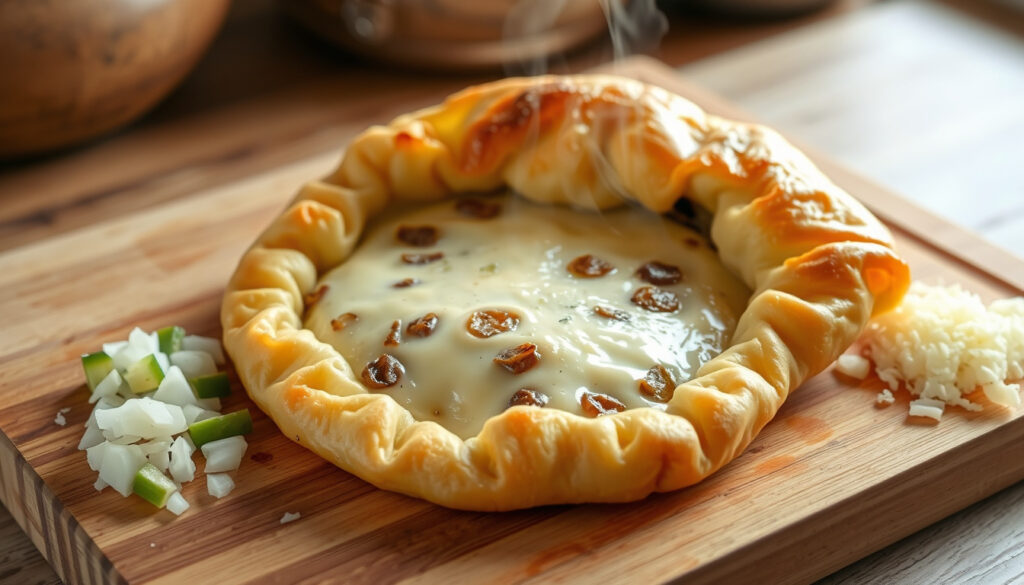
Cheese and Onion Pasty Recipe: Step-by-Step Guide
There’s something deeply satisfying about pulling a golden, homemade cheese and onion pasty from the oven. That first bite of flaky pastry giving way to a warm, cheesy filling is pure comfort. Potato is optional in the filling, with many recipes including it for texture and others leaving it out entirely, a choice documented by home baking sites like Don’t Go Bacon My Heart (UK home baking blog). Whether you prefer shortcrust or puff, this step-by-step guide covers the techniques that prevent sogginess and deliver a pasty worth bragging about.
Total calories (approx.): 450-550 per pasty ·
Prep time: 30 minutes ·
Cook time: 25-30 minutes ·
Servings: 4 pasties ·
Filling base: cheese, onion, potato (optional)
Quick snapshot
- Shortcrust pastry is the traditional choice for cheese and onion pasty (Alice Fevronia (homemade pastry specialist))
- Egg wash creates a golden crust (Taming Twins (parenting and food blog))
- Potato is optional in the filling (Don’t Go Bacon My Heart)
- Exact calorie count varies by brand and ingredient choices (Culinary Ginger (food blog) suggests ~225g mash per pasty)
- Prep: 30 min; Bake: 25-30 min at 200°C (Taming Twins)
- Filling must be cooled before assembly to avoid softening pastry (Don’t Go Bacon My Heart) (Taming Twins)
- Serve hot or cold; pair with ketchup, brown sauce, or chutney (Alice Fevronia)
- Rest dough 30 min before rolling for tender pastry (Alice Fevronia)
Five key facts about the cheese and onion pasty stand out across UK recipe sources.
| Label | Value |
|---|---|
| Prep time | 30 min |
| Cook time | 25–30 min |
| Calories per pasty | 450–550 kcal |
| Servings | 4 pasties |
| Key ingredient | Cheddar cheese, onion, potato (optional) |
How do I make a cheese and onion pasty?
Ingredients needed
- For the pastry: 225g plain flour, 100g cold butter, 1 egg, 2 tbsp milk, 1 tsp vinegar (Alice Fevronia)
- For the filling: 2 medium potatoes, 1 large onion, 150g mature cheddar, salt, pepper, butter
- Optional add-ins: Dijon mustard, parsley, cream (Don’t Go Bacon My Heart)
Step-by-step assembly
- Boil potatoes in salted water for 15-20 minutes until soft (Taming Twins)
- Fry onions in butter for 5-10 minutes until soft and transparent
- Cool filling completely before assembling (Don’t Go Bacon My Heart)
- Roll pastry to 3mm thick, cut 15cm circles or rectangles
- Place filling on one half, brush edges with beaten egg, fold and crimp (Instructables (DIY guide))
- Prick top to vent steam
Baking instructions
- Preheat oven to 200°C (180°C fan) (Taming Twins)
- Brush pasties with egg wash, avoid over-applying; too much can make pastry soggy (YouTube video (home baker))
- Bake for 25-30 minutes until golden brown
- Rest for 5 minutes before serving
Cooling the filling is non-negotiable. Warm filling will melt the butter in the pastry before it reaches the oven, turning a crisp pasty into a greasy mess. Plan ahead: make the filling an hour before assembly.
The implication: proper filling preparation is the foundation of a successful pasty.
What is the best pastry for cheese and onion pasty?
Shortcrust pastry
- Traditional choice, gives a crisp, sturdy base (Alice Fevronia)
- Vinegar in the dough keeps it tender and flaky
- Ideal for chunky fillings with potato
Puff pastry
- Yields a flakier, lighter texture (My Gorgeous Recipes (food blog))
- Seal with egg wash and crimp with a fork to prevent leaks
- Bake at high heat (200-220°C) for quick puff
All-butter pastry
- Butter improves flavour compared to margarine
- Both shortcrust and puff benefit from all-butter (Taming Twins)
- Rest dough 30 min before rolling to relax gluten
Shortcrust holds up better against moist fillings, while puff pastry offers a more dramatic texture but demands a tighter seal and higher oven temperature. For a Greggs-style pasty, puff pastry is the go-to.
The pattern: shortcrust favours structural integrity; puff favours flaky luxury.
Do cheese and onion pasties have potatoes?
Traditional Cornish pasty filling
- Authentic Cornish pasties contain beef, potato, swede, and onion
- Cheese and onion pasties are a modern vegetarian variant
- Potato is a common addition in home recipes
Modern variations
- Many recipes include diced or mashed potato for bulk and texture (Culinary Ginger (food blog) uses about 225g mash per pasty)
- Some versions skip potato entirely for a richer cheese flavour (Don’t Go Bacon My Heart includes potato as optional)
- Greggs pasty does not contain potato; it’s purely cheese and onion in puff pastry
The pattern: potato is a filler that stretches the cheese and adds moisture. Skipping it concentrates the cheese taste but may make the filling denser. Home bakers should decide based on their preference for texture.
What goes with cheese and onion pasty?
Sauces and condiments
- Classic pairings: ketchup, brown sauce, or fruity chutney
- Onion relish is a traditional accompaniment
- Tomato sauce for a crowd-pleasing option
Side dishes
- Pair with pickled onions for contrast
- Fresh salad or coleslaw adds crunch and acidity
- Baked beans, chips, or a simple soup for a full meal
For a true British pub-style experience, serve a pasty alongside a pint of ale and a side of pickled onions.
How do you prevent a soggy bottom pasty?
Blind baking the pastry base
- Not common for pasties, but a pre-baked bottom shelf helps
- Use a thick pastry base (at least 3mm) (Alice Fevronia)
- Bake on a preheated metal tray for heat contact
Drain excess moisture from filling
- Cool filling completely before assembling (Don’t Go Bacon My Heart)
- If using frozen vegetables, thaw and pat dry
- Avoid over-wetting the filling: no extra liquid
Bake on a preheated tray
- Place pasties on a hot baking sheet to set the base quickly
- Ensure oven is fully preheated before baking
- Egg wash only on the top; if it runs onto the tray, it can steam the base
Soggy bottoms happen when steam gets trapped under the pastry. The combination of a thick base, cooled filling, and a hot baking sheet is your best defence. Don’t skip the steam vents on top.
The catch: even with perfect technique, a soggy base can sneak in if the oven isn’t fully preheated.
What is the 3 cheese rule?
Cheese combinations for flavor
- Use three different cheeses for depth: cheddar, Red Leicester, and Parmesan is a common mix
- Cheddar provides the melt; Red Leicester adds colour; Parmesan gives sharpness
- All cheeses should be grated before mixing
Recommended cheese types
- Mature cheddar is the backbone of any pasty
- Gruyère or Emmental can replace Red Leicester for a sweeter note
- A handful of crumbled Stilton or blue cheese adds punch (optional)
The 3-cheese rule originated in the UK pub-food scene as a way to maximise flavour without excess fat. For a pasty, the key is balance: one strong, one melting, one salty.
Step-by-step guide to perfect cheese and onion pasties
- Make the filling: boil potatoes, fry onions, grate cheese. Mix and cool completely.
- Prepare pastry: for shortcrust, rub butter into flour, add egg, milk, and vinegar. Rest 30 min in fridge (Alice Fevronia).
- Roll pastry to 3mm thickness. Cut into 15cm circles or rectangles.
- Place 2-3 tbsp filling on one half. Brush edges with beaten egg.
- Fold pastry over, press edges to seal. Crimp with fingers or a fork.
- Place on a parchment-lined baking sheet, brush tops with egg wash (avoid excess), and cut 2-3 small steam vents in the top.
- Bake at 200°C (or 180°C fan) for 25-30 minutes until deep golden.
- Cool on a wire rack for 5 minutes before serving.
The most common mistake among home bakers is assembling with warm filling. That one step is responsible for more soggy pasties than any other. Chill the filling for at least 30 minutes before you even think about rolling dough.
What this means: patience at the cooling stage directly determines the pastry’s final texture.
What we know and what’s uncertain
Confirmed facts
- Shortcrust pastry is the traditional choice for cheese and onion pasty (Alice Fevronia)
- Egg wash creates a golden crust (Taming Twins)
- Potato is optional in cheese and onion pasty (Don’t Go Bacon My Heart)
What’s unclear
- Whether all recipes use sautéed onion – some use raw grated onion for a sharper flavour
- Exact calorie count varies widely by brand of cheese and pastry; estimates range from 420 to 600 kcal per pasty (My Gorgeous Recipes)
Expert perspectives
“Cooling the filling before assembling is key to preventing a soggy pastry. It’s the single most important step.”
— Don’t Go Bacon My Heart (UK home baking blog)
“Brush the edges with beaten egg to seal the pasty well, but don’t overdo the egg wash on the top – too much can make the pastry soft.”
— Taming Twins (parenting and food blog)
For home bakers in the UK, the choice between shortcrust and puff pastry is clear: shortcrust for traditional texture, puff for flaky layers. Either way, mastering the crimp and the rest time will separate a soggy pasty from a golden masterpiece.
For a similar take on this classic filling, try our cheese and onion pie recipe for a hearty pie version.
Frequently asked questions
Can I freeze cheese and onion pasties?
Yes. Assemble and freeze unbaked pasties on a tray. Once solid, transfer to a bag. Bake from frozen, adding 5-10 minutes to the cooking time.
What cheese is best for a cheese and onion pasty?
Mature cheddar is the classic choice. For the 3-cheese rule, add Red Leicester and Parmesan for depth.
How long do cheese and onion pasties last in the fridge?
Baked pasties can be refrigerated for up to 3 days in an airtight container. Reheat in the oven to restore crispness.
Are cheese and onion pasties vegetarian?
Typically yes, as long as the cheese is made with vegetarian rennet and the pastry uses butter rather than lard. Check labels.
Can I make cheese and onion pasties with puff pastry?
Absolutely. Puff pastry gives a lighter, flakier result. Seal with egg wash and bake at 200°C for 20-25 minutes.
Do you have to use egg wash on pasties?
Egg wash gives the pasty a glossy golden finish. Milk or cream can substitute, but the colour will be paler.
More related posts
 Windows 10 Media Creation Tool: Download & USB Guide
 Apple Trade In UK – Guide to Values, Process and Eligibility
 Basketball Hoop Buying Guide Ireland: Wall, Portable & Full Size
 Stop Post Nasal Drip Immediately: Fast Remedies
 End of Ramadan 2025 – Date, Eid and Moon Sighting Guide
 Jennifer Love Hewitt: Biography, Kids, Net Worth, Career
 Compare the Market NI – Best Alternatives for Energy Broadband Insurance
 Football Matches Today On TV – Full Schedule And Channels
