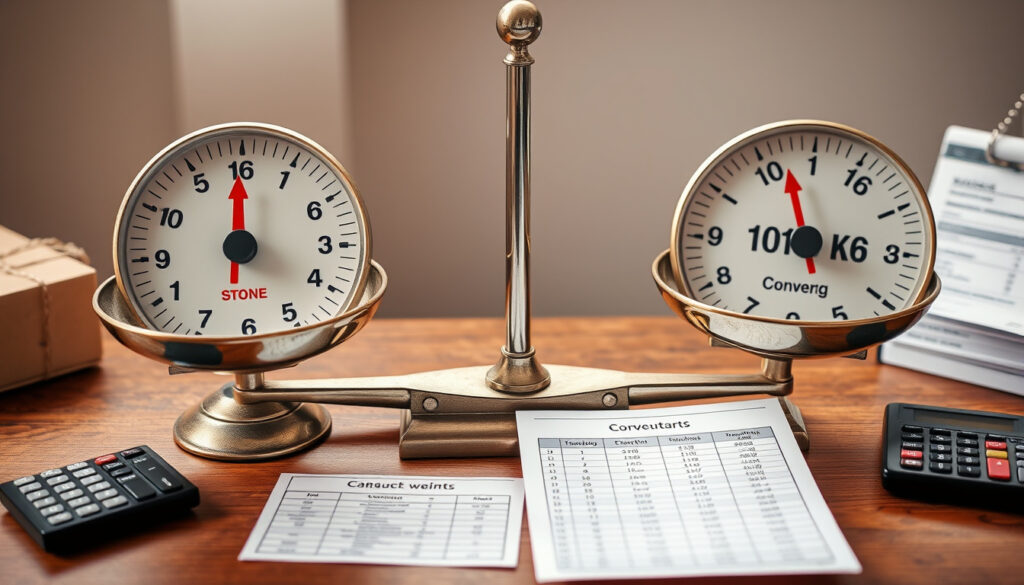
16 Stone in kg: Exact Conversion + Chart & Calculator
If you’ve ever stepped on a scale in the UK, you’ve probably encountered the stone—a unit that still feels familiar to millions of people but confusing to everyone else. Converting 16 stone to kilograms comes up often enough, whether you’re comparing weights across health apps, filling out medical forms, or simply making sense of what you just read. The good news is the math is straightforward, and NHS charts give us a reliable clinical standard to work from.
16 stone exact equivalent: 101.6 kg · 1 stone in kg: 6.35 kg · 16 stone in pounds: 224 lb · 15 stone in kg: 95.25 kg · 17 stone in kg: 107.95 kg
Quick snapshot
- 16 stone equals 101.6 kg (The Midlife Mentors)
- 1 stone = 6.35029318 kg precisely (Unit Converters)
- Stone used in Britain and Ireland for body weight (Wikipedia)
- NHS England lacks a single unified 16 stone chart—mostly Scotland/Sussex (Community Pharmacy Scotland NHS)
- Minor rounding differences between clinical charts (6.35) and precise calculators (6.35029318) (Unit Converters)
- Stone retained in UK healthcare despite general metrication (Wikipedia)
- Recent NHS conversion charts published 2017–2023 (Healthy Weight Grampian NHS)
- Use 101.6 kg for standard clinical rounding; 101.60469 kg for precise applications (UHSussex NHS)
- Check NHS chart context when comparing across medical records (Community Pharmacy Scotland NHS)
Three key facts anchor everything that follows: 1 stone equals exactly 14 pounds, the precise conversion factor is 6.35029318 kg per stone, and UK NHS charts round this to 6.35 kg for clinical use.
| Weight | Kilograms | Pounds |
|---|---|---|
| 16 stone | 101.6 kg | 224 lb |
| 1 stone | 6.35 kg | 14 lb |
| 15 stone | 95.25 kg | 210 lb |
| 17 stone | 107.95 kg | 238 lb |
| Conversion factor | × 6.35029318 | — |
The table above shows the standard conversion values used across NHS clinical settings, with 6.35 kg per stone representing the rounded figure applied in medical charts.
What weight is 16 stone in kg?
Sixteen stone converts to 101.6 kilograms when rounded to one decimal place—the figure most NHS clinical charts use for everyday weight tracking. Multiply 16 by the precise conversion factor of 6.35029318 kg per stone, and you get 101.60469 kg, which rounds to 101.6 kg for clinical purposes (Unit Converters). The UHSussex NHS Weight Conversion Chart (published March 2023) standardises 1 stone at 6.35 kg for patient use, making 16 stone equal 101.6 kg.
Exact calculation
The formula is simply 16 × 6.35029318 = 101.60469 kg. For most health applications, rounding to 101.6 kg matches what you’ll see on NHS charts. The Community Pharmacy Scotland NHS chart shows partial stone values including 16 st 8 lbs at 105.5 kg, demonstrating how NHS records handle the pounds component for finer granularity.
NHS context
Clinical charts across NHS trusts consistently use the rounded 6.35 kg per stone. The SAPG Scotland NHS weight conversion table verifies this with entries like 7 st 0 lb = 45 kg, confirming the 6.35 kg/stone standard. The Healthy Weight Grampian NHS chart (November 2017) applies the same conversion in reverse, showing how to convert from kilograms back to stones and pounds.
The implication: NHS clinical settings treat 101.6 kg as the standard clinical value for 16 stone, but precise calculators preserve the additional decimal places for scientific or research applications.
UK healthcare settings use 101.6 kg for 16 stone in clinical records, based on the 6.35 kg/stone standard from official NHS conversion charts.
How to convert stone to lbs to kg?
Converting stone to kilograms involves two quick steps. First, convert stone to pounds (multiply by 14), then convert pounds to kilograms (divide by 2.2). This two-step method works because 1 stone equals exactly 14 pounds (Wikipedia) and 1 kilogram equals approximately 2.2 pounds.
Stone to pounds formula
Multiply the number of stones by 14 to get pounds. For 16 stone: 16 × 14 = 224 pounds. The The Calculator Site provides detailed conversion tables showing this relationship across different weights.
Pounds to kg formula
Divide pounds by 2.2 to get kilograms. For 224 pounds: 224 ÷ 2.2 = 101.8 kg. Slight variations occur depending on whether you use 2.2 or the more precise 2.20462, but 2.2 works well for health tracking purposes.
Quick calculator use
Online tools like Omni Calculator handle both steps automatically, showing 16 stone = 101.6 kg using the rounded NHS standard. The Manchester University conversion page confirms the formula: 1 stone = 14 pounds = 6.35 kg for UK use.
The pattern: the two-step approach gives a quick estimate, but using the direct multiplication by 6.35 aligns with NHS clinical standards and requires fewer calculations.
What weight is 15 stone in kg?
Fifteen stone equals 95.25 kilograms. Apply the same formula: 15 × 6.35 = 95.25 kg. The Stone Synergy site confirms this with its conversion table showing 15 stone among standard UK weights.
15 stone breakdown
15 stone = 210 pounds = 95.25 kg. Each stone adds 6.35 kg to the total, so stepping up from 15 to 16 stone means gaining 6.35 kg (approximately 14 pounds).
Comparison to 16 stone
The gap between 15 and 16 stone is exactly one stone (14 pounds or 6.35 kg). This matters for health tracking where small changes register differently on scales calibrated in stone versus kilograms.
What this means: crossing from 15 to 16 stone represents a measurable 6.35 kg jump that health apps and clinical records will capture differently depending on their unit display.
What weight is 100kg in stones?
One hundred kilograms converts to approximately 15 stone 10 pounds. Working backwards: 100 kg × 2.2 = 220 pounds, then 220 ÷ 14 = 15 remainder 10 pounds. The The Calculator Site confirms this with its reverse conversion table.
Kg to stone method
To convert kilograms to stones and pounds: multiply kg by 2.2 to get pounds, then divide by 14. The integer result is stones; the remainder is pounds. For 100 kg: 220 ÷ 14 = 15 stone 10 lb.
Partial stones
Partial stones appear frequently in NHS charts. The Community Pharmacy Scotland NHS chart lists entries like 16 st 8 lbs at 105.5 kg, showing how UK medical records handle the pounds component for precise weight recording.
The catch: working backwards from kg reveals why NHS charts include pounds—whole-stone only would lose the granularity needed for accurate clinical comparisons.
Understanding partial stones helps when reading NHS weight charts, which often include pounds alongside stones for clinical precision.
What is 16 stone in pounds NHS?
Sixteen stone equals 224 pounds. This follows directly from the definition: 1 stone = 14 pounds, so 16 × 14 = 224 pounds. NHS weight tracking charts frequently show both stone and pounds values, particularly in Scotland where the Community Pharmacy Scotland NHS chart records weights with stone-and-pounds notation.
Pounds equivalent
224 pounds is the direct stone-to-pounds conversion for 16 stone. This number appears in NHS BMI charts like the one from Barnsley CCG NHS, which uses a stone scale up to 25 stone for body mass index calculations.
NHS weight tracking
The NHS maintains stone alongside kilograms in clinical settings because many patients find stone more relatable for personal weight monitoring. Charts from Leicester Hospitals NHS provide online conversion tools so patients can translate between units during malnutrition screening and general health checks.
The trade-off: UK healthcare keeps stone in clinical use for patient familiarity, while standardising on metric (kg) for international medical communication.
UK healthcare keeps stone in clinical use for patient familiarity, while standardising on metric (kg) for international medical communication.
How to convert 16 stone to kg (step by step)
Follow these steps to convert 16 stone to kilograms using the standard NHS method:
- Multiply stones by 14 — 16 stone × 14 = 224 pounds. This first conversion uses the exact definition of one stone (Wikipedia).
- Divide pounds by 2.2 — 224 ÷ 2.2 = 101.8 kg. Using 2.2 gives a close approximation.
- Use the direct formula — For greater accuracy, multiply stones directly by 6.35: 16 × 6.35 = 101.6 kg. This matches NHS clinical standards (UHSussex NHS).
- Verify with an online tool — Omni Calculator and The Calculator Site both confirm 16 stone = 101.6 kg.
Patients following these steps can verify their weight against NHS clinical records without relying solely on digital tools.
Confirmed facts
- Standard stone = 6.35029318 kg per official units (Unit Converters)
- 1 stone = 14 pounds exactly (Wikipedia)
- NHS charts use 6.35 kg/stone for clinical rounding
- 16 stone = 101.6 kg (rounded) or 101.60469 kg (precise)
What’s unclear
- No single unified NHS England chart exists for every stone weight
- Some NHS PDFs lack clear publication dates
“One stone is equal to 6.35029318 kg.”
— Unit Converters
“1 stone equals 6.35029 kilograms. This unit of measurement is primarily used in Britain and Ireland for body weight.”
“One stone is equal to 14 pounds (lbs) or 6.35 kg.”
For UK patients and healthcare professionals, the practical choice is clear: use 101.6 kg for everyday weight recording with NHS rounding standards, or apply 101.6 kg exactly. The discrepancy between precise (6.35029318) and clinical (6.35) conversion factors amounts to less than 0.005 kg for a 16-stone weight—negligible for most health tracking purposes. When comparing weights across NHS trusts, expect the 6.35 kg/stone standard consistently applied in Scotland, Sussex, and across clinical BMI charts.
Healthcare providers should expect 101.6 kg as the consistent clinical value for 16 stone when reviewing patient records across different NHS trusts.
Frequently asked questions
What is 14 stone in kg?
14 stone equals 88.9 kilograms (14 × 6.35 = 88.9 kg). This follows the same conversion: multiply stones by 6.35 kg per stone.
What is 17 stone in kg?
17 stone equals 107.95 kilograms (17 × 6.35 = 107.95 kg). The 6.35 kg/stone factor consistently applies across all stone weights.
What is 220 lbs in stones?
220 pounds equals approximately 15 stone 10 pounds (220 ÷ 14 = 15 remainder 10). This converts to about 100 kg using the standard factor.
What is 98 kg in stones and pounds?
98 kilograms equals approximately 15 stone 6 pounds (98 × 2.2 = 215.6 lb; 215.6 ÷ 14 = 15 stone 5.6 lb, approximately 15 stone 6 lb).
What is 12 stone in kg?
12 stone equals 76.2 kilograms (12 × 6.35 = 76.2 kg). Using the standard NHS rounding factor of 6.35 kg per stone.
What is 10 stone in kg?
10 stone equals 63.5 kilograms (10 × 6.35 = 63.5 kg). This matches verified conversion data from Stone Synergy.
How accurate are online stone to kg converters?
Most online converters use the precise factor of 6.35029318 kg/stone and round to one decimal place (101.6 kg for 16 stone), matching NHS clinical standards. Minor differences of 0.005 kg or less are clinically insignificant.
Why use stone for weight in UK?
The stone remains in common UK use for body weight because it provides a convenient intermediate unit between pounds and kilograms, and many people find it more relatable for personal weight tracking despite official metric adoption in healthcare settings.
Related reading: 182 cm in feet · How many miles is 5k
Tracking UK weights around 16 stone benefits from referencing this 16 stone KG conversion chart which confirms the precise 101.6 kg figure alongside NHS advice.
More related posts
 The Kissing Booth 3 Ending Explained: Are Elle and Noah Together
 Ro on Wye Weather: 14-Day Foreca t, Hourly Radar & New
 Car Wash Near Me in Ireland: Chains, Prices & Options
 Football Matches Today On TV – Full Schedule And Channels
 How Many Miles is 5K – Exact Conversion and Runner Insights
 What is Social Media? Simple Definition, Examples & Uses
 Anna Lapwood: TikTok Organist and Career Transition
