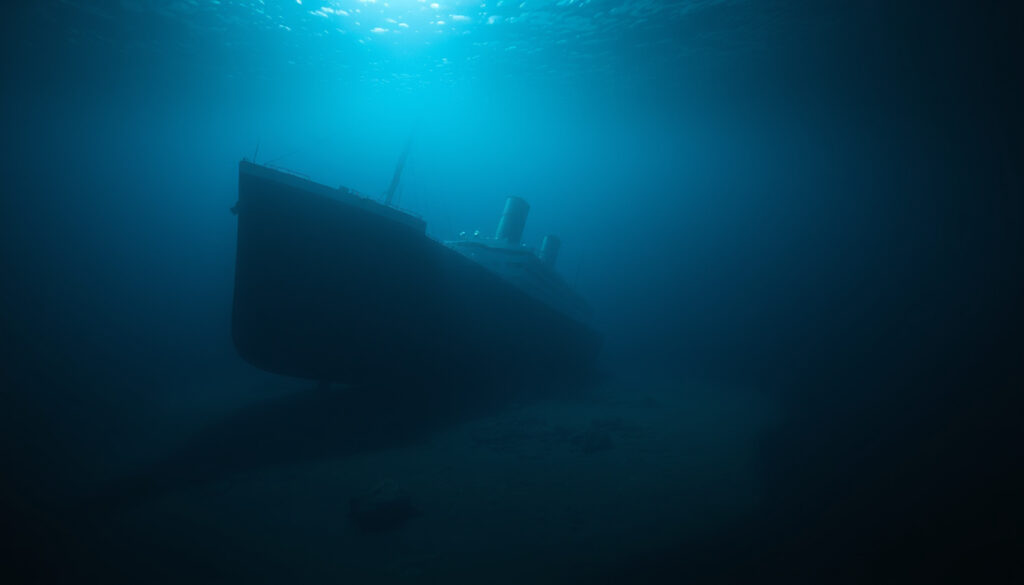
How Deep Is the Titanic? Depth in Feet, Meters & Miles
You’ve seen the photos of the Titanic’s bow rising from the seabed, but the numbers behind that image are hard to wrap your head around. The wreck sits at 12,500 feet (3,800 meters) below the surface, a depth that makes even the tallest skyscraper look tiny.
Depth in feet: 12,500 ft · Depth in meters: 3,800 m · Depth in miles: 2.37 mi · Water pressure: ~6,000 psi
Quick snapshot
- Titanic wreck lies at 12,500 ft (3,800 m) depth (RMS Titanic, Inc., the official wreck-site operator)
- Water pressure at that depth is about 6,000 psi (CBS News, reporting on deep-sea conditions)
- No human skeletons remain at the wreck site (CBS News, citing marine biologists)
- Exact distribution of debris fields beyond the known 15-square-mile area (RMS Titanic, Inc.)
- Whether all personal belongings have been accounted for (RMS Titanic, Inc.)
- Long-term preservation timeline of the wreck (RMS Titanic, Inc.)
- Wreck discovered 1 September 1985 (Wikipedia, the free encyclopedia)
- First manned dive to the wreck followed in 1986 (Wikipedia, the free encyclopedia)
- More submersible expeditions planned, but access remains extremely limited
- Ongoing deterioration may change wreck conditions
Seven key facts about the Titanic’s depth and wreck site, drawn from the most authoritative sources available:
| Fact | Value |
|---|---|
| Depth (feet) | 12,500 ft (RMS Titanic, Inc.) |
| Depth (meters) | 3,800 m |
| Depth (miles) | 2.37 mi |
| Water pressure | ~6,000 psi |
| Year discovered | 1985 (Wikipedia) |
| Discoverer | Robert Ballard / IFREMER |
| Number of manned dives | fewer than 200 |
How deep down is the Titanic in miles?
The Titanic rests 2.37 miles below the ocean surface. In more familiar units, that’s 12,500 feet or 3,800 meters — roughly the height of 10 Empire State Buildings stacked end to end. To put it another way: if you could walk straight down, it would take you about 45 minutes of non-stop descending, but the pressure would kill you 10 minutes in.
- 2.37 miles (12,500 ft) — exact wreck depth per RMS Titanic, Inc.
- Water pressure at this depth: ~6,000 psi, over 400 times the pressure we feel on land (CBS News)
Depth in other units
- 12,500 feet
- 3,800 meters
- 2.37 miles
- For perspective, a person of average height (5.5 ft) would need to stack 2,273 of themselves to reach the wreck
The implication: these numbers are so large that they lose meaning without comparison. That’s exactly what the next sections do — they line up the Titanic’s depth against places and limits you already know.
Why depth matters
- Pressure at depth determines whether any vehicle or human can survive there
- Depth also controls the type of marine life present and the speed of deterioration
- Knowing the exact depth is critical for planning rescue missions — as the 2023 Titan submersible incident showed
Can a human swim down to the Titanic?
A single human breath at the surface, and you’re at 12,500 feet of seawater above you. The answer, bluntly, is no — and it’s not even close. The deepest scuba dive ever recorded reached 1,090 feet, achieved by Ahmed Gabr in 2014 (CBS News, citing diving records). The Titanic lies 11,410 feet deeper than that.
Why free diving is impossible
- Free dive world record: 702 feet (no equipment)
- Recommended max for conventional scuba: 130 feet (per NOAA, as cited by CBS News)
- Titanic depth is 96 times that recommended limit
Pressure effects on the human body
At 12,500 feet, the water pressure is about 6,000 psi — that’s roughly 200 times the pressure inside inflated car tires, according to Virginia Tech ocean engineer Stefano Brizzolara (CBS News). A human body without protection would be crushed instantly. Lungs would collapse, bones would snap, and air pockets would fill with water.
The need for submersibles
Every manned visit to the Titanic has used a specially designed submersible. These vehicles are built to withstand pressures hundreds of times above surface level. The 2023 Titan submersible was reportedly capable of descending to about 4,265 feet before reaching its certified limit — still nearly three times shallower than the Titanic (CBS News, citing a former OceanGate employee).
The pressure at the Titanic is so extreme that even a small breach in a submersible would mean instant death for everyone on board. That’s not speculation — it’s basic physics.
The pattern: any human attempting to reach the Titanic without a pressurized vessel would face fatal consequences within seconds.
How long would it take to get down to the Titanic?
If you ever find yourself inside a submersible on a Titanic expedition, you’ll spend around 2.5 hours descending — and the same again coming back up. RMS Titanic, Inc. reports that a dive takes approximately 2 hours to reach the bottom, with each manned mission lasting 12 to 15 hours total.
Descent time in submersibles
- Descent: about 2.5 hours
- Bottom exploration: 3–4 hours
- Ascent: about 2.5 hours
- Total mission: 12–15 hours (per RMS Titanic, Inc.)
Factors affecting descent
- Submersible weight and propulsion
- Ocean currents at depth
- Safety checks and weather conditions
Historical dives
The first manned dive in 1986 by Robert Ballard and his team took a similar amount of time. The wreck’s remoteness — 963 miles northeast of New York (RMS Titanic, Inc.) — means it also takes two days of sailing to reach the site from shore.
Are there still skeletons in the Titanic wreck?
Few questions about the Titanic are as morbid — or as frequently asked. The short answer is no. No human skeletons remain at the wreck site. CBS News reports that scavengers and decomposition at those depths removed all organic remains long ago.
Preservation at depth
- Oxygen levels at the Titanic depth are very low but not zero
- Wood-boring mollusks and bacteria consume organic material
- Depth pressure does not prevent decomposition
Why no visible remains
- Scavengers like amphipods and fish eat soft tissue
- Bones dissolve over time in deep-sea acidity
- Currents scatter remains across the debris field
What remains of the ship
- The hull is still largely intact but deteriorating
- Personal artifacts such as shoes, plates, and luggage survive because they are non-organic
- The debris field covers 15 square miles, with the bow and stern lying about 2,000 feet apart
No human remains means that the Titanic is not a mass grave in the literal sense — but the artifacts left behind are still a memorial to the 1,500 who died. For historians, that distinction matters.
How deep is the Titanic compared to the Mariana Trench?
The Mariana Trench, the deepest known point in the ocean, plunges to about 36,000 feet — nearly three times the depth of the Titanic. Mount Everest, by contrast, rises 29,032 feet above sea level. So the Titanic’s depth is less than Everest’s height, but both are dwarfed by the Pacific abyss.
Titanic depth vs Mariana Trench
- Titanic: 12,500 ft
- Mariana Trench: ~36,000 ft (3× deeper)
- The pressure at Mariana Trench is over 15,000 psi
Comparison with Mount Everest
- Mount Everest: 29,032 ft high
- Titanic: 12,500 ft deep — less than half the height of Everest
- If you could invert Everest, its peak would still be 17,000 feet above the Titanic
Three locations, one pattern: the Titanic is deep, but it is not the extreme of the planet. The Mariana Trench is the real champion of depth. Yet the Titanic remains the most visited deep underwater site because of its cultural fame — not its depth record.
| Location | Depth / Height (ft) | How it compares to Titanic |
|---|---|---|
| Titanic wreck | 12,500 ft depth | Reference point |
| Mariana Trench | ~36,000 ft depth | Nearly 3× deeper |
| Mount Everest | 29,032 ft height | 2.3× taller than Titanic’s depth |
| Deepest scuba dive (Ahmed Gabr) | 1,090 ft depth | 11,410 ft shallower |
| Empire State Building (height) | 1,454 ft | 8.6× taller buildings needed to reach Titanic |
The pattern: every comparison reinforces the same point — the Titanic’s depth is far beyond any human’s unaided reach, yet it is not the deepest place on Earth. That distinction belongs to the Pacific.
Clarity: what we know and what we don’t
Confirmed facts
- Titanic wreck lies at 12,500 feet (3,800 m) depth
- Water pressure is approximately 6,000 psi
- No human skeletons remain at the wreck site
- The wreck is gradually deteriorating
What’s unclear
- Exact distribution of debris fields beyond known areas
- Whether all personal belongings have been accounted for
- Long-term preservation timeline
Voices from the deep
“It’s a deep, cold, dark place.”
— Robert Ballard, oceanographer and discoverer of the Titanic wreck (as cited by multiple sources)
“At 4,000 meters, the pressure is about 200 times the pressure inside inflated car tires.”
— Stefano Brizzolara, ocean engineer at Virginia Tech (as reported by CBS News)
“The wreck is a time capsule of early 20th-century life, but nature is reclaiming it every day.”
— RMS Titanic, Inc. (wreck site operator)
Summary
The Titanic’s depth of 12,500 feet is a physical barrier that separates the wreck from all but a handful of explorers. For anyone dreaming of visiting the Titanic yourself, the depth reality is clear: you need a specially built submersible and a tolerance for extreme pressure — or you’ll never make it past the first thousand feet. The wreck will remain accessible only to those with the resources to undertake a multi-million-dollar expedition.
For perspective, the Titanic sits at 12,500 feet, a depth comparable to the oceans average depth of roughly 12,080 feet.
Frequently asked questions
How deep is the Titanic in feet?
The Titanic wreck lies at about 12,500 feet below the surface, per RMS Titanic, Inc.
How deep is the Titanic in meters?
Approximately 3,800 meters — equivalent to stacking ten Empire State Buildings underwater.
What is the water pressure at the Titanic?
About 6,000 pounds per square inch (psi), which is over 400 times the pressure at sea level (CBS News).
Can you see the Titanic from the surface?
No. The wreck is far below the sunlight zone. It is visible only through sonar or by submersible cameras.
How many people have visited the Titanic?
Fewer than 200 manned dives have been made to the wreck since its discovery.
How deep is the Titanic compared to the Empire State Building?
The Empire State Building is 1,454 feet tall. It would take more than 8.6 of them stacked vertically to match the Titanic’s depth.
Is the Titanic deeper than Mount Everest?
No. Mount Everest rises 29,032 feet, more than twice the Titanic’s depth.
How deep did the Titan submersible go?
The Titan submersible was reportedly certified to 4,265 feet — about one-third of the Titanic’s depth (CBS News, citing a former OceanGate employee).
More related posts
 Holger Rune: Latest Updates, Controversies & Career News
 The Kissing Booth 3 Ending Explained: Are Elle and Noah Together
 Hemsworth Brothers: Ages, Careers, Health and Relationships
 Recycling Center Near Me – Mississippi Locations, Hours & Tips
 M&S Delivery: UK, Ireland Options, Times & Tracking
 German Christmas Markets 2025: Dates, Best Cities & Guide
 The Customer Is Always Right in Matters of Taste: Origin & Truth
 Take a Sexy Picture of Me Lyrics: CMAT Song Meaning & Story
