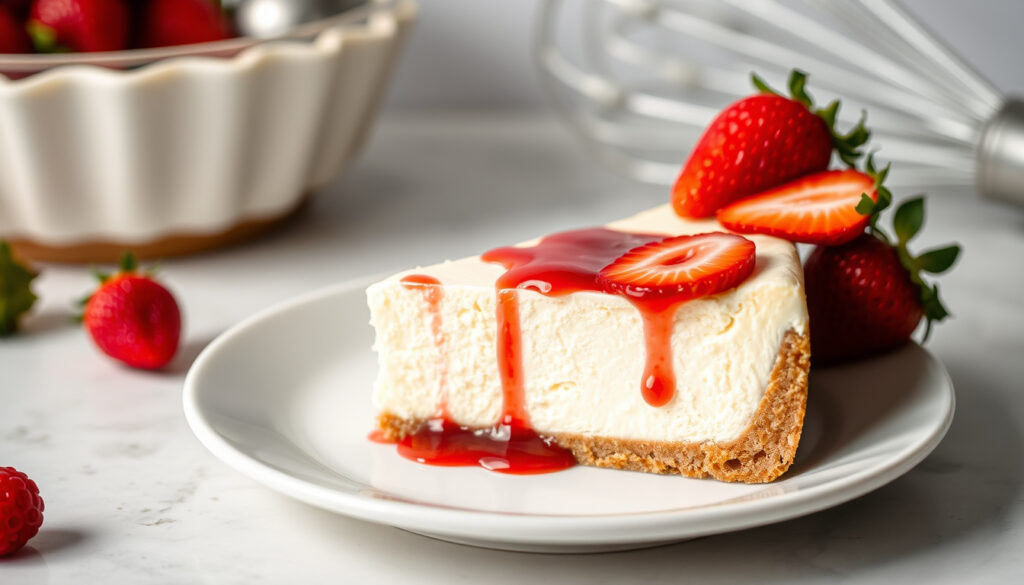
How to Make Cheesecake: Perfect Baked and No-Bake Recipes
Anyone who has ever stared down a cracked cheesecake or a soupy no-bake filling knows the frustration—and the curiosity. This guide cuts through the guesswork, explaining exactly how each method works and why ingredients behave the way they do. Whether you are aiming for a dense, baked classic or a quick chilled dessert, you will find the science and the shortcuts that deliver consistent results.
Average preparation time: 30 minutes for no-bake; 20 minutes prep + 1 hour bake for classic ·
Number of ingredients (classic): 6 core ingredients ·
Calories per slice (8-inch): 350–450 kcal ·
Most popular variation: Strawberry cheesecake ·
Storage life in fridge: 5–7 days
Quick snapshot
- Rich, dense texture from eggs and slow baking (Sally’s Baking Addiction (popular recipe blog))
- Light and creamy, set by chilling rather than heat (Sugar Spun Run (trusted dessert resource))
- Minimal effort: cream cheese, condensed milk, lemon juice – no eggs, no oven (Sugar Spun Run (no-bake specialist))
- Uses pre-made crust, lower oven temperature, fewer cracks (Sally’s Baking Addiction (beginner-friendly tips))
Four approaches, one decision: do you want the oven to do the work or the fridge? Each path changes texture, time, and the ingredients you need.
| Fact | Value |
|---|---|
| First recorded cheesecake recipe | Ancient Greece, around 2000 BC |
| Cream cheese invented | 1872 by William Lawrence in New York |
| No-bake cheesecake popularity surge | 1950s with Jell-O recipes |
| Most searched cheesecake topping | Strawberry |
What are the ingredients for cheesecake?
Essential ingredients for a classic baked cheesecake
- Cream cheese – the primary fat and structure. Full-fat cream cheese is non-negotiable for the best texture (Sally’s Baking Addiction (recipe developer)).
- Sugar – granulated white sugar, typically ½ to ¾ cup per 8-inch cake.
- Eggs – provide structure and richness; baked cheesecake uses 3–4 large eggs (BBC Good Food (trusted home-cook resource)).
- Vanilla extract – 1–2 teaspoons for flavor.
- Graham cracker crust – crushed crackers, melted butter, and a pinch of sugar.
Ingredients for no-bake cheesecake
- Cream cheese – same as baked, but must be softened for smooth blending (Sugar Spun Run, no-bake method specialist).
- Heavy cream – whipped to create a light, airy texture without eggs.
- Sugar – fine granulated or powdered sugar dissolves more easily.
- Lemon juice or gelatin – acid or gelatin helps set the filling.
- Cookie crust – digestive biscuits or graham crackers with melted butter.
Common substitutions
- Mascarpone or quark – similar fat content and tang, good alternatives for cream cheese (Sally’s Baking Addiction, ingredient guide).
- Greek yogurt – must be strained overnight to remove excess moisture; works in no-bake recipes with added gelatin.
- Cashew cream – soak and blend raw cashews with lemon juice and sweetener for a vegan cheesecake base.
The pattern: the ingredient list is short, but each component plays a specific role. Eggs build structure in baked versions; whipped cream and acid do the same without heat.
How to make cheesecake at home?
Preparing the crust
- Crush graham crackers (or cookies) into fine crumbs. Use a food processor or bag and rolling pin.
- Mix with melted butter (typically 5 tbsp for 1½ cups crumbs) and a tablespoon of sugar.
- Press firmly into the base of a springform pan – a flat-bottomed glass helps distribute even pressure (Sugar Spun Run, crust technique).
- For baked cheesecake, pre-bake the crust for 8–10 minutes at 325°F to set it.
Making the filling
- Bring cream cheese to room temperature – this is the single most important step for a smooth, lump-free batter (Sally’s Baking Addiction, pro tip).
- Beat cream cheese and sugar until creamy, then add eggs one at a time (for baked) or incorporate whipped cream (for no-bake).
- Add vanilla and, for no-bake, lemon juice or dissolved gelatin.
- Pour filling over crust. Tap the pan gently to release air bubbles.
Baking vs chilling
- Baked: bake at 325°F in a water bath (wrap pan in foil, place in a larger pan of hot water) to prevent cracking (BBC Good Food, classic baked method).
- No-bake: refrigerate for at least 4–6 hours, ideally overnight, to fully set (Sugar Spun Run, chilling time).
Tips for perfect texture
- Room temperature ingredients prevent lumps – cold cream cheese creates a grainy batter.
- Do not overmix once eggs are added; excess air can cause cracks during baking.
- Cool baked cheesecake gradually: turn off the oven and crack the door for an hour, then cool completely on the counter before refrigerating (Sally’s Baking Addiction, cooling method).
What this means: the difference between a silky cheesecake and a cracked one is often just a few degrees and a little patience. The water bath and gradual cooling are your insurance.
What is the 3 ingredient cheesecake?
Ingredients and ratios
- 8 oz (225 g) cream cheese, softened
- 1 can (14 oz) sweetened condensed milk
- ¼ cup fresh lemon juice (about 2 lemons)
- Optional: a pre-made graham cracker crust
That is it. No eggs, no heavy cream, no vanilla. The acid from the lemon juice reacts with the condensed milk to thicken and set the filling (Sugar Spun Run, 3-ingredient base).
Step-by-step method
- Beat cream cheese until smooth, then gradually beat in condensed milk.
- Add lemon juice and mix until just combined – the mixture will thicken quickly.
- Pour into crust and smooth the top.
- Refrigerate uncovered for 5–10 minutes to set the surface, then cover and chill for at least 4 hours.
Serving suggestions
- Top with fresh berries, a berry compote, or a drizzle of chocolate sauce.
- Slice with a warm, dry knife for clean cuts.
- This version is lighter and tangier than a classic cheesecake, ideal for a quick dessert.
The catch: because the filling sets through acid denaturation, it never becomes as firm as a baked cheesecake. It stays soft, almost mousse-like – perfect for those who prefer a less dense texture.
How to make a simple cheesecake?
Simple crust options
- Buy a pre-made graham cracker crust – saves time and ensures even thickness.
- Or make a quick crumb crust with any plain cookie (digestives, shortbread) and melted butter.
Easy filling without water bath
- Use a lower baking temperature: 325°F instead of 350°F reduces the risk of cracks (Sally’s Baking Addiction, temperature tip).
- Skip the water bath and instead place a pan of hot water on the lower oven rack – this adds humidity without the hassle.
- Do not open the oven door during baking. Sudden temperature changes cause sinking.
No-fail tips
- Use full-fat cream cheese – low-fat versions introduce extra water and alter firmness (Sally’s Baking Addiction, fat content warning).
- Let the cheesecake cool in the oven with the door ajar for one hour after baking – no sudden shock.
- Refrigerate for at least 4 hours before slicing – even a baked cheesecake needs time to set completely.
Why this matters: simple does not mean lower quality. Controlling oven temperature and cooling pace gives you a clean, professional result without the water bath ritual.
What can I replace Philadelphia cream cheese with?
Best alternatives for cream cheese
- Mascarpone – similar fat content, slightly sweeter, works well in both baked and no-bake recipes. Use a 1:1 substitution.
- Quark – a German-style fresh cheese; lower fat but still creamy. Add a tablespoon of butter per 8 oz to match cream cheese richness.
- Neufchâtel – very close to American cream cheese, with ⅓ less fat. Acceptable for no-bake, but may produce a slightly softer set (Sally’s Baking Addiction, substitution notes).
Using Greek yogurt or ricotta
- Greek yogurt – strain overnight through cheesecloth to achieve a thick, spreadable consistency. Use only in no-bake recipes with added gelatin or cornstarch to compensate for lower fat.
- Ricotta – blend until smooth. It is grainier than cream cheese and works best in baked cheesecakes where the eggs help bind the texture. Drain ricotta first to remove excess whey.
Vegan options
- Cashew cream – blend 1½ cups soaked raw cashews with ¼ cup water, 2 tbsp lemon juice, and 2 tbsp maple syrup. Use as a 1:1 substitute in no-bake recipes.
- Store-bought vegan cream cheese – many brands now produce a stable block that behaves almost identically to dairy cream cheese. Test with your recipe’s texture requirements first.
The trade-off: every substitution changes the final texture or flavor. Mascarpone adds richness, ricotta adds grain, cashew cream adds nuttiness. There is no perfect clone, but the best choice depends on your method and tolerance for deviation.
Home cooks who substitute blindly often end up with a runny or dense cheesecake. Understanding the role of fat and acid in each method lets you swap confidently – a 1:1 substitution only works if the chemistry matches.
Confirmed facts
- Cream cheese is the standard base for both baked and no-bake cheesecakes (Sally’s Baking Addiction, ingredient overview).
- Eggs provide structure in baked cheesecake by coagulating during heat (BBC Good Food, baking science).
- No-bake cheesecake requires at least 4 hours of chilling to set properly (Sugar Spun Run, chilling guideline).
- Water bath baking reduces cracking by lowering the temperature gradient around the pan (Sally’s Baking Addiction, water bath explanation).
What’s unclear
- The exact origin of the 3-ingredient cheesecake recipe is unknown – it likely emerged from 1950s home-economics circles.
- No single cream cheese substitute works universally for all methods; results vary by fat content and water activity.
- Optimal baking temperature differs slightly across ovens – 325°F is a widely recommended starting point, but individual calibration matters.
- The most searched cheesecake topping may vary by region and season; available data reflects general internet trends.
“The base is a biscuit base, and then a cream cheese filling rather than a custard – it’s much simpler than it looks.”
– Mary Berry, TV chef and cookbook author, in her BBC Good Food baked cheesecake guide (BBC Good Food, recipe source)
“Room-temperature ingredients are the secret to a silky, smooth batter. Cold cream cheese is the number one cause of lumps.”
– Sally McKenney, founder of Sally’s Baking Addiction (Sally’s Baking Addiction, baking tips)
“The water bath might seem fussy, but it is the single most effective way to avoid cracking. The gentle, even heat keeps the edges from overbaking before the center is done.”
– America’s Test Kitchen, cooking science team (Sally’s Baking Addiction, ATK method referenced)
Baked cheesecake fans get a dense, sliceable cake with a crisp crust. No-bake fans get a creamy, mousse-like dessert with almost no active cooking time. The trade-off: patience in the water bath versus patience in the fridge.
For home cooks learning how to make cheesecake, the choice between baked and no-bake is not about difficulty – it is about texture preference and time. Beginners who start with a simple baked version at 325°F with a water bath will rarely face a cracked top. For those who want dessert on the table in under an hour of active work, no-bake is the clear winner. The implication is straightforward: pick the method that fits your schedule, then respect the ingredients – room-temperature cream cheese, gentle heat, and enough cooling time. That is the recipe for success every time.
Related reading: no-bake cheesecake recipe · classic cheesecake recipe
For a foolproof approach, try this step-by-step cheesecake recipe which covers every step in detail.
Frequently asked questions
Can I use low-fat cream cheese for cheesecake?
Yes, but expect a softer texture and slightly different flavor. Low-fat cream cheese contains more water, which can make the filling less firm, especially in baked recipes. For no-bake cheesecake, it may not set as solidly (Sally’s Baking Addiction, fat content impact).
How do I know when my baked cheesecake is done?
The center should still jiggle slightly when you gently shake the pan – it will firm up as it cools. Overbaking causes cracks. Use an instant-read thermometer: 150°F in the center is a reliable doneness signal (BBC Good Food, baking guidance).
Why did my cheesecake crack?
Cracking usually happens because the cheesecake baked too quickly or cooled too abruptly. A water bath, lower oven temperature, and gradual cooling in the oven with the door cracked are the best preventions (Sally’s Baking Addiction, crack prevention). Overmixing the batter can also introduce excess air.
Can I freeze cheesecake?
Yes, both baked and no-bake cheesecakes freeze well for up to 2–3 months. Wrap tightly in plastic wrap and then foil. Thaw overnight in the refrigerator. No-bake cheesecake may weep slightly after thawing, so add topping after defrosting.
How long does no-bake cheesecake take to set?
At least 4 hours in the refrigerator, but 6–8 hours or overnight is better for a clean slice. The filling continues to firm as it chills (Sugar Spun Run, setting time).
What is the best crust for cheesecake?
Graham crackers (or digestive biscuits) with melted butter are the classic choice. For a twist, use crushed Oreos (cream included) or shortbread. The crust should be compacted firmly – a loose crust leads to crumbling slices.
Can I make cheesecake without a springform pan?
Yes, use a deep-dish pie plate or a regular cake pan lined with parchment paper. Removing slices will be trickier, but the recipe still works. For no-bake cheesecake, a pie plate is especially convenient.
How do I make a vegan cheesecake?
Replace cream cheese with cashew cream or store-bought vegan cream cheese. For the crust, use vegan butter or coconut oil. For baked vegan cheesecake, use aquafaba or silken tofu as an egg replacer. No-bake vegan cheesecakes are simpler and often set with coconut cream and agar agar.
For any home cook who has asked “how to make cheesecake”, the answer is not a single recipe but a framework. Baked or no-bake, full-fat cream cheese or a clever substitute – the key is understanding what each ingredient does. The consequence is clear: invest the small effort in temperature control and cooling, and you will have a dessert that looks as good as it tastes. For the time-pressed cook, the no-bake path delivers reliably. For the weekend baker who wants a showstopper, the classic baked version is worth every minute.
More related posts
 The Diplomat Season 3: Cast, Episodes, and Season 4 News
 Stop Post Nasal Drip Immediately: Fast Remedies
 Nissan Qashqai for Sale in Ireland – Used Buying Guide
 Jennifer Love Hewitt: Biography, Kids, Net Worth, Career
 Wales National Rugby Union Team: Players, Salaries, and Decline
 Convert PDF to Word Free: Best Free Converters Compared
 Gujarat Titans vs Rajasthan Royals Match Scorecard – IPL 2024 Match 24 Result
 Multan Sultans vs Lahore Qalandars: LQ Wins by 20 Runs
