Things to Do in Bath: Top Attractions & Itineraries
Bath is deceptively compact — one main square, a handful of historic buildings — yet families who arrive expecting a quick half-day stop routinely find themselves rearranging flights. A UNESCO World Heritage Site built around natural hot springs, Bath packs Roman engineering, Gothic architecture, and wide-open parks into a walkable centre.
Tripadvisor Lists: 10 Best Things · Suggested Stay: 1-3 Days · Key Site: Roman Baths · Family Options: 19 Activities
Quick snapshot
- UNESCO site with natural hot springs reaching 46°C (Visit Bath)
- Bathing not permitted — visitors observe, don’t soak (Visit Bath)
- Adjacent to Bath Abbey for seamless pairing (Visit Bath)
- Gothic architecture with tower tours for ages 5+ (Twins and Travels)
- Stained glass marks Edgar’s 973 AD coronation (Twins and Travels)
- Staircase climbs reveal city panorama (Twins and Travels)
- Modern bathing complex with rooftop pool
- Adults-focused experience
- Separate family sessions available
- Bath City Farm: 37 acres, free admission (Twins and Travels)
- Royal Victoria Park: playgrounds and gardens (Twins and Travels)
- Riverside walks via Pulteney Bridge (Twins and Travels)
Bath’s key facts span UNESCO status, natural spring specifications, and visitor logistics that families need before arriving.
| Detail | Value |
|---|---|
| Main Attraction | Roman Baths |
| Tourism Site | VisitBath.co.uk |
| Review Source | Tripadvisor |
| UNESCO Status | Designated 1987 |
| Spring Temperature | 46°C |
| Daily Water Volume | 1,170,000 litres |
| Water Mineral Count | 43 minerals |
| Roman Baths Construction | Around 70 AD |
| Bath Abbey Tower Age Limit | 5 years minimum |
| Bath City Farm Area | 37 acres |
How do you spend a day in Bath?
Three attractions anchor any full-day visit: the Roman Baths, Bath Abbey, and whatever stretch of the city centre you save for walking off lunch. The good news is that all three sit within a single pedestrianised zone, so transitions between them take under ten minutes on foot. Families with primary-school children will find this compact layout works in their favour — there’s no wasted travel time, and the energy spent walking between sites tends to balance out the energy gained from each stop.
Morning: Roman Baths and Abbey
The Roman Baths deserve a 1.5–2 hour block at the start of the day, according to GetYourGuide’s visitor guide. The site feeds on a natural hot spring that produces over 1,170,000 litres of water daily at 46°C, and the spring water contains 43 minerals that visitors can taste at the Pump Room. Audio guides for children are free, narrated by Michael Rosen, and interactive stations including a Roman Gym with projections keep younger visitors engaged throughout. One practical note: buggies aren’t permitted inside, but carriers and backpacks are provided on-site for babies and toddlers.
- Roman Baths — arrive early to beat peak crowds; allow 1.5–2 hours
- Bath Abbey — combine with the Roman visit for a seamless historical pairing; tower tours open to children aged 5 and over (Twins and Travels)
Afternoon: City exploration
After lunch at Sally Lunn’s — a kid-friendly spot that appears in most one-day itineraries — the afternoon opens into Pulteney Bridge, the Riverside Walk, and either the open-top bus tour (with over 17 stops starting near the Roman Baths) or the parks. Local Passport Family’s one-day blueprint recommends Royal Victoria Park Playground for families, followed by a loop past the Royal Crescent. The city centre is fully pedestrianised around the Roman Baths and Abbey, making this leg straightforward even with strollers.
- Open-top bus — 17+ stops, departs near Roman Baths and Abbey
- Royal Victoria Park — play areas for children, open green space
- Royal Crescent — Georgian architecture and photo opportunities
Evening: Dining and views
Bath’s restaurant scene clusters around the Abbey and the riverside. Families with older children can time an evening meal to catch the sunset from a rooftop venue, while those with younger kids may prefer to call it a day and save the evening for a ghost tour — an optional add-on that several multi-day itineraries flag as particularly memorable for ages 8 and up.
What activities can you do in Bath?
Bath divides its activities into two broad tracks: the historic core, which draws visitors back decade after decade, and the outdoor and family-oriented options that have expanded significantly in recent years. Tripadvisor’s top 10 lists consistently feature the Roman Baths, Bath Abbey, and Thermae Bath Spa alongside lesser-known venues like Bath City Farm and the American Museum & Gardens. The city’s Visit Bath family activities guide catalogues 19 distinct options ranging from safari parks to literature festivals.
Top attractions
- Roman Baths — UNESCO site, interactive children’s programme, audio guides; no swimming allowed
- Bath Abbey — Gothic structure, tower climbs for ages 5+, stained glass depicting Edgar’s 973 AD coronation
- Thermae Bath Spa — modern bathing with rooftop pool; adults primary market
- Pulteney Bridge — 18th-century bridge with shops; riverside walks beneath
Outdoor pursuits
- Bath City Farm — 37 acres, free admission, farm animals, one-mile woodland trail, wildlife pond, wooden fort
- Royal Victoria Park — play areas, gardens, open spaces; ideal for toddlers and primary-age children
- Prior Park Landscape Gardens — Georgian garden near city centre; suitable for families with older children
- Riverside Walk — connects Pulteney Bridge to green spaces downstream
Cultural sites
- American Museum & Gardens — optional extension for families; offers grounds and exhibitions
- Children’s Literature Festival — annual family event hosted in Bath
- Victorian statues — terrace at the Roman Baths lined with 1894-era statues of Roman emperors
Things to do in Bath for adults
While Bath excels at family programming, adults will find the city skews toward sophisticated experiences. Thermae Bath Spa’s rooftop pool offers the only opportunity to bathe in thermal water within the city itself — a genuinely unique experience at sunset. The Abbey tower climb appeals to those who want elevation without exertion, and Visit Bath notes that the museum circuit (American Museum & Gardens, Victoria Art Gallery) provides indoor refuge on wet days. Evening dining clusters along the riverside and around the Abbey, with wine bars and independent restaurants filling Georgian townhouses.
Unusual things to do in Bath
Beyond the obvious attractions, Bath rewards curiosity. The Victoria Art Gallery is free to enter and houses a substantial collection spanning five centuries. GetYourGuide flags the Roman Baths’ Victorian-era terrace statues (installed in 1894) as a detail many visitors miss. Ghost tours operate year-round and suit families with children aged 8 and above; Viator lists these as a memorable evening option for multi-day visitors.
Things to do in Bath for couples
Bath’s compact centre makes it naturally suited to romantic itineraries. Thermae Bath Spa’s rooftop pool opens to adults in the evenings, offering thermal bathing with city views. Local Passport Family recommends Prior Park Landscape Gardens for couples wanting Georgian-era landscape without the crowds. Sunset dining along the riverside — particularly at restaurants reachable via Pulteney Bridge — combines views with the city’s culinary scene.
Bath packs its activity range into a walkable centre, which means families can pivot between a historic site, an outdoor farm, and a cultural museum without logistical stress. The real constraint is time, not distance.
Is 2 days in Bath enough?
Two days covers the highlights with room to breathe, but it requires prioritisation. Families who try to squeeze in every top-10 attraction risk ending up with a rushed itinerary that exhausts both children and adults without allowing any single site to land properly. The smarter play is to treat day one as a historic immersion and day two as an outdoor and cultural extension.
Day 1 highlights
Focus entirely on the Roman Baths and Bath Abbey on the first day. Allocate the full 1.5–2 hours the Roman site needs, add the Abbey tower climb (for children aged 5 and over), and finish with dinner in the city centre. This single day already covers what most visitors consider the core Bath experience.
- Morning — Roman Baths (1.5–2 hours with audio guides and interactive stations)
- Midday — Bath Abbey (tower tour optional, guided tour available)
- Afternoon — Sally Lunn’s lunch, Pulteney Bridge, Riverside Walk
- Evening — city centre dining; optional ghost tour for families with older children
Day 2 extensions
Day two opens up the outdoor attractions and optional day trips. Viator’s multi-day family guide flags Bath City Farm as an ideal half-day option for younger children, while Royal Victoria Park suits any family wanting a low-cost afternoon. Families with older children can add a Stonehenge private tour as a day-trip extension.
- Bath City Farm — 37 acres, free admission; animals and trails
- Royal Victoria Park — playgrounds, gardens, open space
- Open-top bus tour — covers 17+ stops; convenient overview for first-timers
- American Museum & Gardens — cultural half-day for families
Why extend
Three days becomes relevant for families who want to pair Bath with a Stonehenge visit, attend a seasonal event like the Children’s Literature Festival, or simply allow for a slower pace that doesn’t treat every stop as a race. Viator’s three-day plan reserves day three for markets, photography walks, and a final relax before departure.
Two days is enough for the core attractions, but families travelling during school holidays should book Roman Baths tickets in advance. The site draws significant peak-season crowds that can compress the experience if you’re walking in without a reservation.
How to spend 3 days in Bath?
Three days transforms Bath from a whistle-stop heritage visit into a properly paced family break. The first two days cover the historic core and outdoors; day three opens up to markets, optional day trips, and any attractions that didn’t make the first cut. Viator’s three-day family itinerary treats day one as history-focused, day two as nature and outdoors, and day three as markets and relaxation.
Day 1: History
- Roman Baths — guided tour (one hour), interactive children’s sessions, free audio guide by Michael Rosen
- Bath Abbey — tower climb for ages 5+; stained glass and Gothic architecture
- Evening ghost tour — optional add-on for families with children aged 8+
Day 2: Nature
- Bath City Farm — 37 acres, woodland trail, wildlife pond; free admission
- Royal Victoria Park — playgrounds, gardens, open space
- Prior Park Landscape Gardens — Georgian garden for older children
- Riverside Walk — Pulteney Bridge to green spaces downstream
Day 3: Markets and relax
- Weekend markets — local produce, crafts, and food stalls in the city centre
- American Museum & Gardens — cultural visit and garden grounds
- Open-top bus or shopping — leisurely close to the visit
- Optional Stonehenge day trip — private tours from Bath for families; pre-booking required
What to do in Bath for 3 hours?
Three hours is tight, but it’s workable if you pick a single focus rather than attempting a general tour. The Roman Baths alone absorb 1.5–2 hours, which leaves either a fast Abbey visit or a quick park stop in the remaining time. Families with very young children should prioritise the Roman Baths and skip the tower climb; families with primary-age children can combine the Roman site with the Abbey in a tightly scripted 3-hour window.
Quick hits
- Roman Baths only — 1.5–2 hours; audio guides and Pump Room water tasting
- Roman Baths + Abbey exterior — 3 hours including 1.5 hours at Roman site, 30 minutes outside Abbey
- Open-top bus tour — covers 17+ stops in under 90 minutes; best for orientation
Priority sites
The Roman Baths is the non-negotiable anchor for any short visit. The site sits at the heart of Bath’s UNESCO World Heritage zone, and its combination of Roman engineering, natural hot springs, and interactive children’s programming delivers the highest density of experience per minute spent. GetYourGuide’s visitor guide notes that the one-hour guided tours explore the Great Bath and bathing rooms efficiently without requiring the full 2-hour block that self-guided visits demand.
- For first-timers: Roman Baths (1.5 hours) + open-top bus snapshot (1 hour) = 2.5 hours
- For families with ages 5+: Roman Baths (1.5 hours) + Bath Abbey tower (45 minutes) = 2.25 hours
- For bad weather: Roman Baths + Thermae Bath Spa rooftop (if time allows)
Three hours is enough to experience Bath’s single most iconic attraction but not enough to feel the city. If your schedule allows even a fourth hour, add the Abbey exterior or the riverside walk to shift from “seen the Roman Baths” to “visited Bath.”
What we know and what’s still murky
Confirmed
- Bathing is not permitted at the Roman Baths — visitors observe, they don’t soak
- Bath Abbey’s current structure dates from the Victorian era after over 1,000 years of churches on the site
- The city centre is fully pedestrianised around the Roman Baths and Abbey
- Bath City Farm operates with free admission and donations on a 37-acre site
- Bath has held UNESCO World Heritage Site status since 1987
Unclear
- Exact 2026 opening hours and ticket pricing for the Roman Baths
- Current dates for the Children’s Literature Festival in Bath
- Comparative costs of open-top bus tours versus self-guided walking itineraries
- Stroller accessibility details beyond the Roman Baths site
- Weather contingency plans for outdoor itinerary portions
What visitors say
If there is only one place you go to whilst in Bath with kids, then you MUST visit the Roman Baths.
— Twins and Travels (Family Travel Blog)
The first time I visited Bath, I was a small child, and I remember it being a fantastic place to be a kid.
— Viator Author (Travel Writer)
Bath is such a perfect family destination—easy to walk, full of surprises, and gorgeous around every corner.
— YouTube Narrator (Family Vlogger)
The takeaway
Bath earns its reputation as one of Britain’s most child-friendly cities not through gimmicks or entertainment complexes, but through the sheer density of high-quality attractions packed into a walkable centre. The Roman Baths alone justify the trip for families with children aged 5 and over, and the surrounding parks, farms, and historic buildings add enough variety to reward a second or third visit without repeating the same experience. Families who plan for 2–3 days find Bath genuinely relaxing; those who attempt it in three hours leave impressed but vaguely frustrated that they couldn’t stay longer. The city’s UNESCO status, natural hot springs, and mix of Roman, Georgian, and Victorian architecture create a compact package that works for toddlers, primary-age children, and teenagers alike — which is rarer than it sounds.
Related reading: Grand Sirenis Riviera Maya Resort and Spa · Fergus Club Mallorca Waterpark
visitbath.co.uk, romanbaths.co.uk, ourlittlelifestyle.com, romanbaths.co.uk, tripadvisor.com
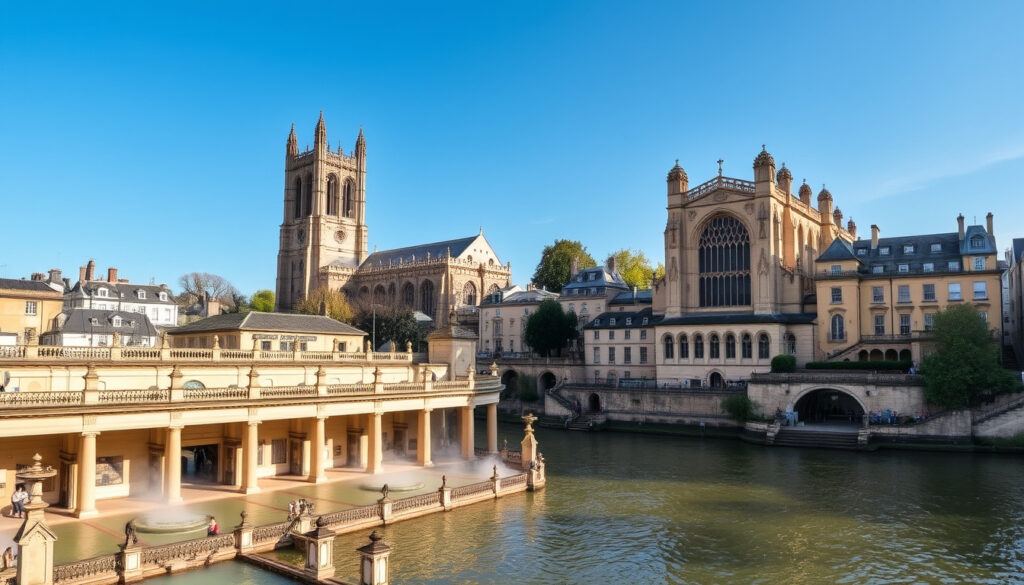
Bath’s UNESCO World Heritage center draws millions annually, with top sites and itineraries mapped out in this Bath attractions guide from local experts.
Frequently asked questions
What day is market day in Bath?
Bath hosts regular weekend markets in the city centre, with farmers’ markets and craft stalls rotating through different locations. Saturday is typically the strongest market day, though specific market locations and dates vary seasonally.
Is Bath an expensive city?
Bath sits in the mid-to-high range for UK tourist destinations. The Roman Baths and Bath Abbey charge admission fees, but outdoor attractions like Bath City Farm (free) and Royal Victoria Park (free) keep family budgets manageable. Booking attractions online in advance often unlocks small discounts.
What are things to do in Bath with kids?
Top options include the Roman Baths (with free children’s audio guides and interactive sessions), Bath Abbey tower climbs for ages 5+, Bath City Farm (37 acres, free admission), and Royal Victoria Park. The Visit Bath family activities guide lists 19 distinct options for families.
What are free things to do in Bath?
Bath City Farm (37 acres, free admission), Royal Victoria Park, Sydney Gardens, and the riverside walk between Pulteney Bridge and the green spaces downstream all cost nothing to enter. Bath Abbey’s exterior is visible from the street without paying, and the pedestrianised city centre encourages wandering.
Can you still bathe in the Roman Baths in Bath?
No. Bathing is not permitted at the Roman Baths site. Visitors explore the historic bathing complex and can taste the spring water at the Pump Room, but the Great Bath and surrounding pools are for observation only. Modern bathing is available at Thermae Bath Spa, a separate facility in the city centre.
Is Bath nicer than York?
Both cities are UNESCO-designated and rich in Roman and medieval heritage. Bath’s compact pedestrianised centre and natural hot springs give it a distinctive character, while York’s Viking history and larger city footprint offer a different scale of experience. Families often visit both on a single UK trip and tend to rate them comparably.
What are things to do in Bath in winter?
Winter is an ideal time to visit Bath for families who want to avoid peak crowds. The Roman Baths, Bath Abbey, and Thermae Bath Spa operate year-round, and indoor attractions like the American Museum & Gardens suit cold-weather days. Weekend markets and shorter queues at top attractions make January through March surprisingly comfortable for family visits.
More related posts
 Red Dress for Women – Top 2025 Trends and Styling Guide
 Ronnie Wood: Age, Net Worth, Wife, Sobriety & More
 Michael Rosenbaum: Why He Left Smallville’s Lex Luthor
 UK Size 6 in EU: Shoes & Clothing Charts
 Recycling Center Near Me – Mississippi Locations, Hours & Tips
 Gillian Anderson: Partner, UK Life, Teetotal & Net Worth (2025)
 African Store Near Me – Find Markets, Hours & Products
 Norwich Asylum Seekers Hotel Protest: Timeline & Costs
